
Ground Work |003| The Business They Buried: How Grand Midwives Were Pushed Out of the Market They Built
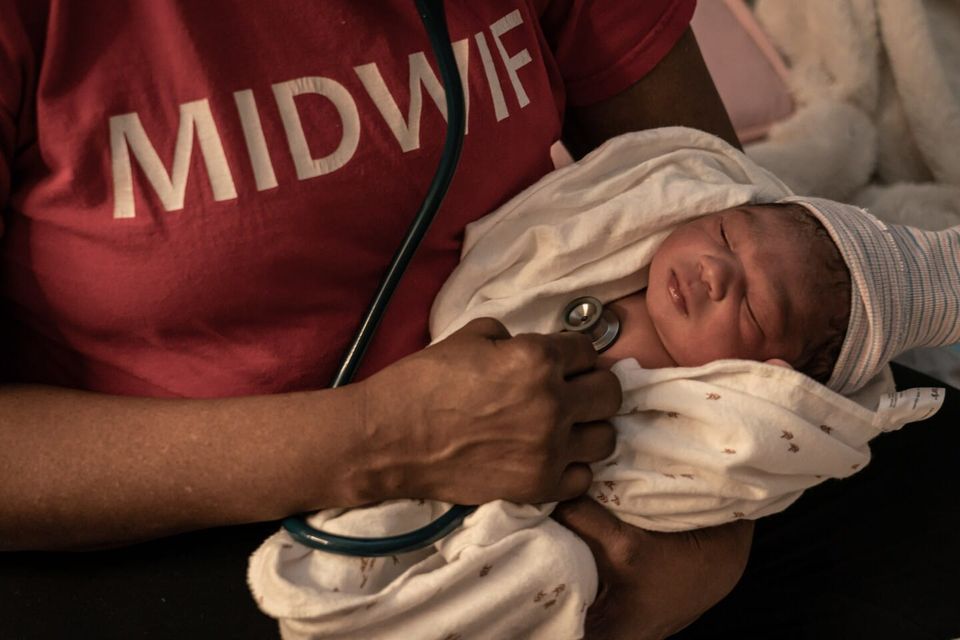
I talked to my Nana, Ardel, known to most of us as Della Mae, quite a bit about birth. She was born in 1937 and grew up right here on this land I call Gertrude Magnolia. She had dementia before she passed away last year, but still remembered so much about what it meant to bring life into the world. She told me about our community's Grand Midwife, Miss Virginia Lee Grant. The smallest woman around. Tiny, but she had so much strength, and she brought so many babies into the world during a time when accessing care at a hospital was nearly impossible for Black people in the South.
My Nana had my grandmother Mariam right here on this land, in the hands of Miss Virginia. I have videos of her talking about it. Nana would scrunch up her face every time she thought about the pain and then smile so wide when she talked about how much she loved all her children. One day, I may share those videos here.
When I spoke to my grandmother about having my mother, born in 1968, the difference was noticeable. By then, Black people were having babies in hospitals. The community Grand Midwife of that era was present, watching for signs of danger, but no longer permitted to practice.
One generation. That is all it took.
What changed between my great-grandmother laboring at home in the hands of Miss Virginia and my grandmother laboring in a hospital with a midwife at her side who could watch but not touch? The answer is not progress, it is business. Birth became a revenue channel and, once it did, the gates that had always been there to keep Black and Brown practitioners out were enforced with the full weight of federal policy. Midwifery, as we know it now, did not become a practice of commodification by accident. It was deliberately built on top of the infrastructure that women like Miss Virginia had already built.
II. Who They Were
Grand Midwives, also referred to as Granny Midwives, were Black midwives who worked with both Black and white communities in the South. Their legacy spans from the 1600s through the mid-to-late 1900s, bridging generations of African ancestral traditions and modern birth care. Granny midwives attended nearly 90% of Black births in the early 1900s.
They were herbalists, spiritualists, counselors, conjurers, and nutritionists. They worked with community across every age and stage of life, from healing the flu, to attending a home birth, to helping someone move through grief and rage in an era when being underresourced was something Black people were expected to be grateful for, because at least they were free.
Grand Midwives connected families to one another for skill-sharing and sharecropping. They held communities together, linking businesses and networks in ways that extended far beyond the birth room. The intimacy of their position made them wisdom keepers and community anchors. During the 20th century, they also served as a crucial link between rural families and early public health initiatives, normalizing prenatal care and child immunization in communities with which the formal health system had no real relationship.
They were entrepreneurs. They understood revenue streams not only in monetary terms but also through bartering, relationship-building, and the expansion of practice through apprenticeship. Following the principles of each one, teach one. Their existence proved something we rarely speak about: folk tradition includes building infrastructure.
III. The Market They Built
What Grand Midwives offered was not a service. It was an ecosystem.
They provided culturally aligned, racially concordant care across a birthing person's entire lifetime, sometimes from childhood through the experience of having a child of their own. They brought herbalism, nutrition, and lactation support. They came to you, at your home, in your community, on your terms. They did not require you to navigate a system that had never been designed with you in mind.
Their payment model was built for the communities they served: groceries, cash when it was available, services, trades, and reciprocal care. A family did not have to go further into debt to have someone present at one of the most significant moments of their lives. The exchange was mutual. The care was not contingent on what you could afford to spend.
Their knowledge was deep and generational. Grand Midwives held an education in physiological birth that physicians of the era lacked. They believed in the body's capacity to birth. They intervened only when intervention was necessary. Birth was not a procedure to move through efficiently. It was a threshold. They walked families across it with presence, patience, and accumulated wisdom passed down through generations of practice.
This was infrastructure. Community-owned, community-resourced, community-sustaining.
When institutional medicine looked at birth in the early twentieth century and saw a revenue channel waiting to be captured, Grand Midwives were not just in the way; they were the competition.
The timing of their ousting was not coincidental. Formerly enslaved communities in the post-slavery period were actively building their own infrastructure, economies, and systems of mutual support. Scholar Sharla M. Fett writes in Working Cures: Healing, Health, and Power on Southern Slave Plantations about the understanding that existed among enslaved people: if we lose our systems of care and medicine, we will be forever controlled, whether under slavery or not. Grand Midwives were part of that infrastructure. Their knowledge was self-determination made into practice.
High perinatal and infant mortality rates became the public justification for removing them. Grand Midwives were blamed for numbers that reflected the conditions of poverty and neglect, not the failures of their practice. With the system restructured around their authority, physicians, many of whom lacked adequate training in physiological birthing practices, took over the primary care of birthing people. The consequences of that restructuring are still being counted. Black perinatal and infant mortality rates in the United States remain the highest of any First World country. Not because the replaced practitioners were failing, but because the practitioners who replaced them were not building for the community. They were building for the institution.
IV. The Mechanisms of Removal
The dismantling of midwifery did not happen through force alone; it happened through policy, through story, and through the deliberate construction of a world that left no room for the practitioners already doing the work. As fear, misinformation, and money pushed Grand Midwives out of communities and into history pages, the communities they served were told this was progress.
The Camera and the Erasure
All My Babies: A Midwife's Own Story was produced in 1953 by the Georgia Department of Public Health. It follows Mary Francis Hill Coley, an African American midwife in Albany, Georgia, as she delivers babies and moves through her community with authority, care, and deep knowledge. The film is genuinely beautiful as it captures a Black woman doing sacred work with skill and with love.
The film, however, was also a trap.
All My Babies was created to train midwives in hygiene and prenatal protocols and to promote cooperation with the modern medical system. In practice, it functioned as a public health instrument designed to regulate and ultimately phase out the very practitioners it depicted. Mary Francis Hill Coley was being celebrated on screen while the system was being built to erase her.
Rather than resourcing the tradition the film documented, the state used it to reinforce the superiority of hospital-centered birth over the community care that had sustained generations. The message underneath the celebration was clear: we see you, we will film you, and then we will replace you.
The Campaigns Built on Racist Lies
Physician-led public health campaigns in the 1940s and 1950s labeled Grand Midwives as ignorant, superstitious, and directly responsible for high infant and maternal mortality rates, leaning heavily on racist stereotypes to make the case.
What they did not say was that those mortality rates reflected the conditions of poverty, neglect, and systemic disinvestment in Black communities, not the failures of midwifery practice. The cause was misnamed deliberately. Shifting the blame onto Grand Midwives worked to redirect public trust toward the medical establishment and away from the practitioners communities already knew and relied on.
In the end, the campaigns worked.
The Policy Pattern
Once public opinion had been shaped, policy followed, making the removal permanent. The mechanisms changed over time, but the logic stayed the same: money flows to institutions, not to practitioners.
The Sheppard-Towner Act of 1921 introduced licensing requirements, rigid training standards, and certification processes designed to exclude traditional, apprentice-trained Black and Indigenous midwives. State licensing laws expanded that framework, requiring credentials, in-person training, and, in many cases, direct physician supervision, which made home birth practice effectively illegal. Many of these laws required literacy or formal education, which Granny midwives had been systematically denied for generations. The requirement was not neutral. It was a barrier built to look like a standard. By the time Medicaid was created in 1965, reimbursement structures were built entirely around physician and hospital-based care. Midwives were not included. No inclusion meant no payment. No payment meant no sustainable practice.
The Hill-Burton Act of 1946 completed the shift. Federal funding poured into hospital construction across the country, incentivizing a wholesale move away from home birth toward institutionalized, physician-led childbirth. Public dollars built the system that replaced community-based care. Community-based care received nothing.
The World Built Around the Hospital
Policy alone did not finish the job. The physical world was rebuilt to match.
Highway construction and urban renewal projects deliberately cut through Black communities, disrupting the neighborhood infrastructure that had supported community-based care for generations. When the physical community is fragmented, the practitioners embedded in it lose their networks, their clients, and their ability to practice.
Ambulance and emergency transport infrastructure were built entirely around hospitals. As car ownership expanded and roads multiplied, the cultural assumption that birth belonged in a hospital was reinforced by the literal infrastructure for getting help in an emergency. Home birth became associated with risk not because it was riskier, but because every safety system was built to point away from it.
The Organized Opposition
None of this happened without active lobbying.
The American Medical Association (AMA) worked throughout this period and into the latter half of the twentieth century to politically oppose midwifery at every level. This was not passive competition between two approaches to birth. It was an organized, sustained political opposition by a professional body with significant lobbying power, aimed at protecting a market. The AMA shaped legislation, influenced licensing boards, and used its institutional authority to ensure that midwifery remained legally and financially marginalized long after the public health campaigns had done their work.
Each mechanism arrived wearing the language of public health, safety, and modernization. Each one functioned to consolidate control, concentrate profit, and remove the practitioners closest to the communities they served.
This did not happen by accident. It happened by design.
V. What the Numbers Tell Us Now
The dismantling did not stay in the past. It is producing outcomes right now, in every funding meeting, every state legislature, and every rural community watching its labor and delivery unit close.
Granny midwives attended nearly 90% of Black births in the early 1900s. Today, Black midwives make up approximately 2% to 7% of the total midwifery workforce in the United States, and many are hospital-based. The community midwife, the one who comes to you, who knows your family, who practices the way Miss Virginia practiced, is nearly gone.
The demand did not go with her. According to The Journal of the American Medical Association (JAMA) Health Forum, home births among Black women rose over 36% in 2020. The interest is there. The practitioners are not. That gap is not a market failure. It is a policy outcome.
Medicaid is often where funders stop looking, as if reimbursement solved the problem. It did not. Medicaid reimbursement for midwifery care currently averages $1,500 to $3,500 for a standard package. The market rate for that same care is generally at least triple the amount. Practitioners are expected to absorb that difference and call it service. That is not a sustainable model; it is a familiar one.
States like Alabama, which has one of the highest Black birth populations in the country and the highest maternal mortality rate in the United States, still do not have laws that support the education, business development, or sustainability of community midwives. Maternity deserts are common there. Labor and delivery units close every year because they cannot generate enough profit to stay open. Midwives are not being supported or incentivized to fill the gap that those closures leave behind.
The question that history keeps asking and policy keeps avoiding is a simple one.
Is profit more important than people?
VI. What Rebuilding Requires
Understanding the history is not enough. Naming the policy is not enough. At some point, the question becomes: what does repair actually look like, and who is willing to do it?
Not charity. Repair. Those are not the same thing.
Come prepared to unlearn.
Whatever you think you know about this work, set it down before you enter the room.
Community midwifery does not fit a classic investment framework. It was not built to. It was built in tradition, in relationship, in the kind of entrepreneurship that sustained entire communities long before there was language for impact investing, care economy, or patient capital. That is not a limitation. It is the source of its strength.
If midwives in the early 1900s were attending nearly 90% of births in the South and finding ways to sustain themselves and their communities without institutional support, there is something worth learning there. Not just as history. As a model. The lessons are not only in the conflict between physicians and midwives, the policy battles, or in the negative outcomes that followed the dismantling. They are also in the surviving traditions. In the knowledge that came across the ocean on boats, that moved through slavery and Reconstruction and Jim Crow and every attempt to erase it, and still found ways to bring life into the world. That knowledge was innovative. It was adaptive. It built ecosystems from nothing.
This work requires deep listening. It requires unlearning what the market has told you care should look like. Then it requires learning again, this time from the people closest to the work, from the history they carry, and from the communities they serve.
You are not coming in to fix something broken. You are coming into a resource, something that was deliberately interrupted. That is a different posture entirely.
See midwives as the entrepreneurs they are.
Grand Midwives were never just caregivers. They were business owners, knowledge holders, and ecosystem builders. That has not changed. Community midwives today are running businesses, managing client relationships, navigating complex legal landscapes, and creating networks that hold entire communities together.
They do not need to scale to matter. The ecosystem does not require one dominant practice. It requires many midwives, working together in community, building businesses that are sustainable at their current size. The goal is not growth for growth's sake. It is durability. An ecosystem of ten thriving community midwifery practices does more for a region than a single large practice trying to serve everyone.
Fund with reparative capital first.
Reparative capital is not a punishment for past harm and it is not charity. It is an honest accounting of what was taken and what rebuilding actually requires.
Funding that is seen as foundational rather than transactional changes what is possible from the beginning. It reduces the instability that arises from building on a financial model never designed to sustain this work. It also requires breaking out of the belief that money is the only capital worth exchanging. With reparative capital comes relationship capital, the networks, introductions, and sustained presence that open doors. It comes with human capital, the mentorship, the knowledge sharing, the investment in people, not just programs. All of it together is what repair looks like in practice.
Provide more than a check.
Financial capital alone does not build sustainable midwifery practices. Community midwives need access to legal support, financial planning, business development, and operational infrastructure. Most of them are navigating all of that without support, on top of the clinical work itself.
An investment that comes with wraparound services is not a luxury. It is the baseline for changing outcomes and the only way to achieve the goal of a thriving community midwifery ecosystem.
Understand the timeline.
This is not a two-year return. It is not a five-year return. The infrastructure that was dismantled was built over generations and destroyed over decades. Rebuilding it requires an investment horizon that is honest about that scale.
What you will see in return is not a financial multiple. It is a reduction in maternal mortality. It is a community with access to culturally aligned care. It is a midwifery workforce that reflects the communities it serves. It is a labor and delivery unit that does not have to close because a community midwife is already there. Those returns do not appear on a balance sheet. They are real.
Patient capital is not a charitable gesture. It is the only financial model honest enough to fit this work.
VII. Closing
I want to return to where this essay began.
My Nana Ardel, Della Mae, labored on this land in the hands of Miss Virginia Lee Grant. The smallest woman around. Tiny. Full of strength. She brought so many babies into the world during a time when the system had already decided she did not belong in it. She practiced anyway. She sustained anyway. She held her community anyway.
Miss Virginia understood something the system has never been able to account for. The knowledge she carried was worth more than the institutions trying to replace her. She knew it. The families she served knew it. The community knew it.
What the Sheppard-Towner Act could not legislate away. What the Hill-Burton Act could not build over. What the public health campaigns could not lie out of existence. What the AMA could not lobby into irrelevance. The knowledge survived. It moved through generations the way all essential things move, not through institutions but through people. Through women like Miss Virginia, passing it to the next set of hands. Through families like mine carrying the memory of what it felt like to be cared for on your own terms, in your own home, by someone who knew your name.
That knowledge is still here. It is in the community that midwives practice today in states that make their work as difficult as possible. It is in the doulas sitting with laboring people inside systems that are still not sure they belong. It is in the herbalists, the birth workers, and the practitioners building ecosystems in communities that the market has never properly valued.
The ground has always been here.
What rebuilding requires is not a new idea. It is a return to an old one, with resources this time. With legal support, financial planning, patient capital, and the willingness to unlearn everything the market taught you about what care is worth. With the humility to sit at the feet of a tradition that brought life into the world for generations before any of us had the language for impact investing, care economy, or reparative capital.
Miss Virginia did not need that language. She just needed to be resourced instead of replaced.
We are still asking for the same thing. The ask has not changed. What needs to change is the answer.
So has the knowledge. It is time to invest like we know it.