Common Ground |Issue 003| The Business They Buried
🌱 ROOT & GROUND
I have been thinking about land.
At the peak of Black land ownership in the United States, around 1910, Black Americans owned approximately 16 to 19 million acres. Today, that number is closer to 2 million. That reduction did not happen slowly or naturally; it happened through deed fraud, heirs' property laws, tax sales, violence, and intimidation. It happened through intention.
Forty acres and a mule was real. Special Field Order No. 15 redistributed approximately 400,000 acres of confiscated Confederate land to formerly enslaved families in 1865. Within months of Lincoln's assassination, Andrew Johnson reversed the order and returned the land to its former Confederate owners. The families who had already begun building were removed.
What was taken was not just acreage; it was the foundation of generational wealth. Land is collateral, inheritance, community infrastructure, and economic anchor all at once. There are families across this country still fighting for land their ancestors owned, navigating tangled deed histories and court systems that were never designed to return what was taken.
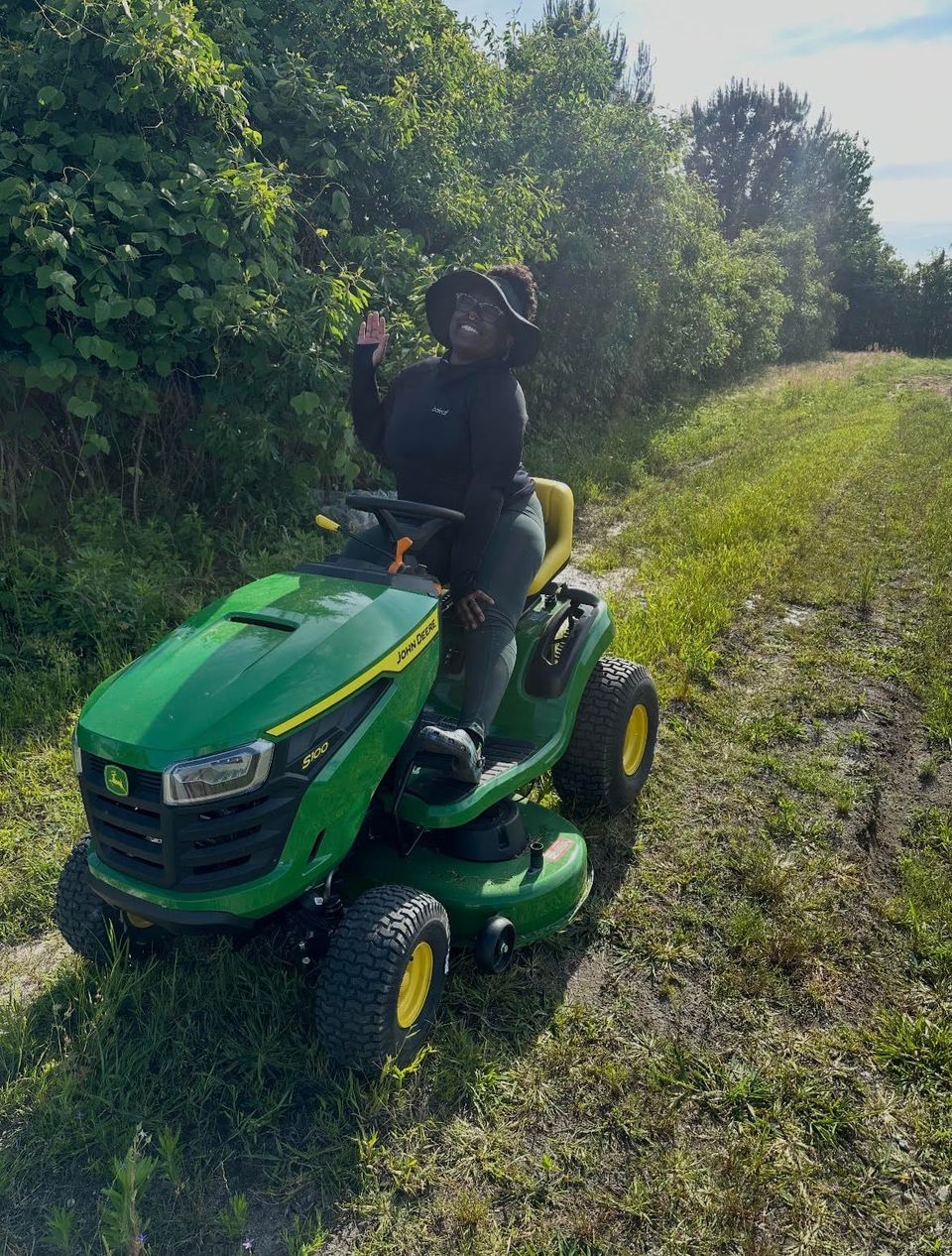
I think about this when I walk Gertrude Magnolia. I think about what it means that we still have it. I think about what it costs to keep it. Land is wealth. Land is memory. Land is the ground on which everything else gets built.
The fight to hold onto it has never stopped.
🌿 THE PLANT ALLY · Red Raspberry Leaf (Rubus idaeus) For the long labor. For building what sustains.
Red Raspberry Leaf grows along roadsides and woodland edges, her leaves serrated and soft on the underside.
She has been used by midwives and healers across cultures for centuries. Grand Midwives knew her. They used her to tone the uterus, soften the cervix, support the final weeks of pregnancy, ease labor, and strengthen the body after birth. She is mineral-dense, rich in iron, calcium, magnesium, and potassium. She is the plant you reach for when the work ahead is long, and the body needs to be ready.
How to work with her this season: Steep one to two teaspoons of dried red raspberry leaf in hot water for ten to fifteen minutes. Drink freely. She is cumulative in her effects. Like most things worth building, she rewards patience.
A note from your neighborhood clinical herbalist in training: Use caution during pregnancy and drink freely once you are full term. If you have a hormone-sensitive condition or are on blood thinners, check with your care provider first.
💡 THE GROUND TRUTH The Business They Buried
Granny midwives attended nearly 90% of Black births in the early 1900s. Today, Black midwives make up approximately 2% to 7% of the midwifery workforce in the United States. That gap was not accidental. It was built.
Grand Midwives were herbalists, spiritualists, nutritionists, counselors, and community anchors. They built ecosystems, operated on mutual aid payment models, and carried generational knowledge rooted in African traditions that survived the Middle Passage. They were the competition when institutional medicine decided birth was a revenue channel worth capturing.
They were pushed out through public health campaigns built on racist lies, licensing laws that required education they had been deliberately denied, and federal policy that funneled money to hospitals instead of practitioners. The American Medical Association (AMA) lobbied against them at every level. The physical world was rebuilt around the hospital, and the community midwife was left outside of it.
The consequences are present right now. Home births among Black women rose over 36% during the pandemic. Medicaid reimbursement for midwifery care averages $1,500 to $3,500, while the market rate is at least triple. States like Alabama still lack laws that support the sustainability of community midwives. Labor and delivery units close every year because they cannot generate profit. Midwives are not being incentivized to fill the gap.
Miss Virginia Lee Grant delivered my grandmother on this land. She did not need a new framework. She needed to be resourced instead of replaced. We are still asking for the same thing.
📋 THE PRACTICAL
For birth workers and doulas: The Midwives Alliance of North America maintains a state-by-state licensure tracker that maps exactly where home birth midwifery is legally supported, restricted, or effectively inaccessible. Know your legal landscape. Find it at mana.org.
For investors and capital allocators: Before your next investment in a maternal health organization, ask what happens to this resource if the funding runs out. Community midwifery practices, birth centers, and doula training programs are not businesses built to be sold; they are infrastructure built to last. Your investment framework needs to reflect that difference before the term sheet is written.
✨ THE ENERGETIC READ
What I am feeling in the collective right now is a grief that has not yet been named out loud. The grief of people as they begin to understand the full scope of what was taken. Not just personally but from their lineage, their community, their profession. The grief that comes when you realize the loss was not accidental, that someone chose it.
That grief deserves space. Grief that goes unnamed tends to live in the body as exhaustion, cynicism, and the feeling that nothing you build will hold.
Naming it does not fix what was taken. Nothing fixes that. Naming it changes what you do with the energy underneath it.
Grief and building are not opposites. The Grand Midwives grieved. They built anyway. Let yourself feel the weight of what this history holds. Then let it move you toward something.
🔗 WHAT'S MOVING
AI is entering maternity care in rural communities. The questions it raises are the same ones this newsletter keeps asking: who benefits, who decides, and whose knowledge is being used to train the system. walb.com/2026/06/12/miles-maternity-care-ai-helping-expectant-moms
Black midwives in Alabama, Georgia, and Mississippi are challenging the regulations being used to push them out of practice. The mechanisms have new names. The logic is the same. thecurrentga.org/2026/06/02/black-midwives-challenge-regulations-in-alabama-georgia-mississippi
The Guardian asked what repairing the harm of enslavement would actually look like. The answers are specific, structural, and worth sitting with alongside everything this issue has named. theguardian.com/news/ng-interactive/2026/apr/21/we-asked-what-repairing-the-harm-of-enslavement-would-look-like-this-is-what-we-found
🤝 THE INTRODUCTION
The Birth Sanctuary in Gainesville, Alabama is the state's first freestanding birth center, founded by Dr. Stephanie Mitchell. Alabama ranked third in the United States for infant and maternal mortality in 2018. In 2019, eight out of every thousand babies born in the state died before reaching one year of age. Dr. Mitchell filled that gap with The Birth Sanctuary.
The state has been trying to close her ever since.
In 2023, the Alabama Department of Public Health adopted regulations requiring birth centers to meet hospital licensing standards, which would make community birth centers functionally impossible to operate. A 2025 court ruling found the state lacked authority to impose those regulations. In January 2026, an appeals court reversed that ruling. The Birth Sanctuary is continuing to pursue further judicial review while remaining open.
This is the same story this issue has been telling, playing out right now in real time, with real midwives and real families in the balance.
Learn more at thebirthsanctuary.com. Support the legal fight directly below.
🕯️ THE DISCERNMENT
Find a still moment before you move on. Place both feet flat on the floor. Take a slow breath and let the weight of what you just read settle rather than pushing it away.
Ask yourself: Beyond money, what types of capital do I actually hold? Relationship. Knowledge. Culture. Time. Trust. Presence. What has been ingrained in me about which of these counts and which does not? What do I want to keep? What do I want to shift?
Stay with what surfaces. The question is the beginning.
In lineage and in work,
Sabia
Doula · Herbalist · Capital Allocator · Founder, BADT · CSO, Orchid Capital
Ground Work publishes every other Tuesday. Forward this to someone who needs it.
Subscribe at ground-work-1.ghost.io