Common Ground | Issue 001
🌱 ROOT & GROUND
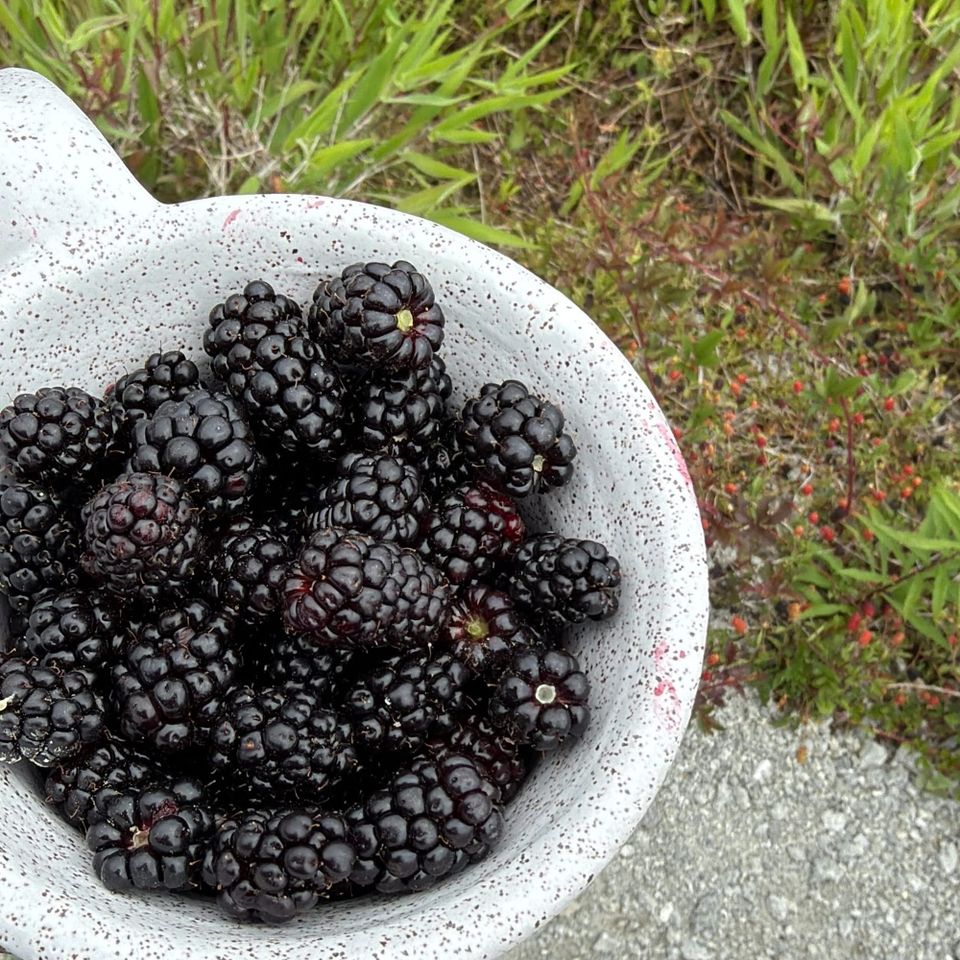
I have been picking dewberries on the land every morning. Our land, named Gertrude Magnolia for my great-great-grandmother Gladys, whose middle name was Gertrude, and for the magnolia tree that has stood here for generations. Barlie, my great-great-grandfather, and Gladys bought this land for their liberation. Walking that path, I found myself thinking about them, picking the same berries from the same earth, carrying whatever the weight of the moment was in their bodies.
The path we are all walking right now toward liberation, in the face of blatant and unapologetic hate, is not a new path. It looks different on the surface. The technology is different, the language is different, the specific threats are different. In depth, it is the same walk. For some of you, depending on your ancestry, this may be the first generation in your line to walk toward liberation rather than away from survival. Either way, we are all navigating the same essential question: how deep into the work do we let ourselves go, knowing our resources are needed everywhere and urgently, while also knowing that we cannot pour from a place that has never been filled?
That answer changes for me depending on the season I am in. Some seasons I can go deep. Others, I have to tend the roots before I can tend anything else. What steadies me is remembering that our ancestors held this same tension. The push and pull between urgency and sustainability is not a modern problem. It is the oldest problem in liberation work. They figured out how to carry it. So can we.
No experience is entirely new when we hold our elders and ancestors in reverence. That is not a comfort I take lightly. It is the ground I stand on.
🌿 THE PLANT ALLY · Holy Basil / Tulsi
For an internal hug when nothing feels stable.
Holy Basil has ruffled green leaves touched with deep purple, small clusters of purple and white flowers, and a scent somewhere between mint, cinnamon, and clove. She is a plant that announces herself gently and really gets you together when you ask for her support.
Spring is here, but the weight of this work does not lift with the season. Our nervous systems are carrying a great deal. Holy Basil is an adaptogen, meaning she helps the body respond to physical, chemical, and psychological stress without pushing it in any one direction.
Her medicine includes lowering cortisol, reducing anxiety, improving mental clarity, and supporting immunity. Across many traditions, she is considered sacred and protective: a plant that helps us breathe, process grief, and keep moving through hard seasons.
To drink her: fill a large water container with a handful of Holy Basil, add fruit or herbs if you like, let it sit overnight, strain, and enjoy. She is just as good cold as she is warm.
A note from your clinical herbalist in training: Avoid, or use caution with, Holy Basil if you are pregnant, breastfeeding, or trying to conceive, as it may have anti-fertility effects. Use caution if you have upcoming surgery, hypothyroidism, or diabetes with blood sugar medication. Consult your care provider when in doubt.
💡 THE GROUND TRUTH
My entry into reproductive justice was not through a conference or a course. It was through a jail. As a volunteer doula with the Prison Birth Project in Massachusetts, I watched pregnant incarcerated people be treated as liabilities the moment their bodies stopped generating value for the system and started growing life. That experience taught me something I have never been able to unsee: money and reproductive justice have always been connected. The fact that they are rarely discussed together is not an accident. It is a design.
Capitalism is not just an economic system. It is a set of rules about what has value and who does not, rules written by people with power and limited lived experience of what care actually costs. Those rules have always had a particular relationship with reproduction: with who gets to bring life into the world, under what conditions, and who absorbs the cost. Lactation was commodified before there was a market for breast pumps. Black enslaved women’s bodies were valued for the milk they could produce for their enslavers’ children, often at the expense of feeding their own. Granny midwives attended nearly 90% of Black births in the early 1900s and were systematically pushed out not because they failed, but because federal policy funneled money to medical institutions instead of to the practitioners already doing the work. We are still living with the consequences: a shortage of Black, Brown, and Indigenous midwives alongside one of the highest maternal mortality rates in the developed world. These are not separate facts. They are the same story.
Doula care is walking the same road now. Once dismissed as illegitimate, doulas are being reintegrated into medical systems, not because the system changed its values, but because it found a way to monetize the work. The question worth sitting with is what these practices lose when they become billing codes in a system that consistently puts profit over people.
To my fellow birth workers: this history shapes your pricing, your burnout, and your sense of worth inside systems that have never been sure you belong. To investors: writing checks in reproductive health without this context means repeating the extraction. Care is capital, not metaphorically but literally. Ground Work exists to bridge the gap between the people doing the work and the people with the resources to support it. The ground has always been here. We are arriving together.
📋 THE PRACTICAL
For birth workers and community organizers:
One place to start if you want to understand the legal and policy landscape for doulas in your state: the National Health Law Program’s Doula Medicaid Project maintains a tracker of which states have passed Medicaid reimbursement for doulas, what the requirements are, and what the reimbursement rates look like. Find it at healthlaw.org. The map is both a resource and a document of how uneven the progress has been.
For investors and capital allocators:
Before your next investment in a perinatal health or care economy business, ask one question the pitch deck probably doesn’t answer: Who built the knowledge this product or service is based on? Where did the methodology come from? Whose community was it developed in, and are those people benefiting from it now? The answer will tell you more about the long-term sustainability of the business than most financial models will.
✨ THE ENERGETIC READ
The energy right now is one enormous juxtaposition.
Many of us are holding joy and despair in the same hands. Asking whether it is fair to feel anything good given the state of the world. Then realizing that joy might be the only thing worth holding onto because of the state of the world. Both things. At the same time.
Those of us building families or considering it are sitting with a question that has no clean answer. Is it fair to bring a child into this world right now? Is bringing a child into this world exactly the kind of resistance this moment is asking for?
For those writing checks in reproductive health right now, the question underneath the question is worth naming. Is this investment actually changing something? Is it time to think beyond the check and into what it means to be in genuine relationship with the communities you're funding?
Different questions. Different entry points. Different language.
The same current running underneath all of it.
What are we willing to hold and build? What do we believe is still possible? Birth workers, investors, advocates, parents, and people who are not sure what they are yet. All of us moving through this together, even when it does not feel that way.
That is the common ground.
🔗 WHAT’S MOVING
Three things worth your attention this cycle:
The women's health market is projected to reach $600 billion by 2030. It remains underfunded and under-researched. The number is large. The gap is larger. https://medcitynews.com/2026/04/women-health-market-pwc/
Supreme Court issues a stay, keeping the abortion pill Mifepristone available by mail for now. The words "for now" are doing a lot of work in that sentence. https://medicalxpress.com/news/2026-05-supreme-court-issues-stay-abortion.html
Donette, a clinical herbalist at HoneyBalm Health, shares insights on Herbal Allies for Doulas: Relieve Stress, Boost Energy, and Find Calm on the BADT blog. Info we all can use. https://www.badoulatrainings.org/blog/herbal-allies-for-doulas-relieve-stress-boost-energy-and-find-calm
🤝 THE INTRODUCTION
ReproTLC is a reproductive health organization built on a simple belief: that people deserve access to the full spectrum of reproductive care, regardless of zip code, income, or insurance status.
As Board President, I've watched this organization do the quiet, unglamorous work that rarely makes it into a pitch deck. Direct service. Community navigation. Holding the gap between what the system offers and what people actually need.
If you work in reproductive health funding and you haven't looked closely at what direct service organizations are carrying right now, ReproTLC is a good place to start. If you're a birth worker who wants to understand how advocacy and direct service intersect, same.
Learn more and support their work at reprotlc.org.
🕯️ THE DISCERNMENT
Dr. Saundra Dalton-Smith's 7 Types of Rest framework changed how I think about sustainability in this work. Physical rest is only one piece. There is also mental, emotional, social, sensory, creative, and spiritual rest. Most of us are depleted in ways we have not named yet.
The original book has a faith lens. The framework belongs to everyone.
Take the free Personal Rest Assessment at the link below. Find out where you are most depleted. Sit with what comes up. Then come back and tell me what you found. Reply to this email or find me on Instagram. I mean that genuinely. I want to know.
What type of rest do you actually need right now?
From the ground where care grows,
Sabia
Ground Work publishes every other Tuesday. Forward this to someone who needs it.
Subscribe at bit.ly/groundwork-sabia