
Ground Work |002| Reproductive Justice & Capitalism: Why They Were Never Separate
I. Opening: Two Words That Belong in the Same Sentence
My entry into reproductive justice was not through a conference; it was through a jail. What I witnessed there, pregnant people treated as liabilities the moment their bodies stopped generating value and started growing life, taught me something I have never been able to unsee: money and reproductive justice have always been connected. To understand how deeply this connection runs, it is imperative for us to first define the terms that shape the relationship between reproductive justice and money.
II. Defining the Terms: On Our Own Terms
Reproductive justice. The right to have children, to not have children, and to parent our children in safe and sustainable communities, was coined and formulated by Women of African Descent for Reproductive Justice in 1994. This group of twelve Black women included Dr. Toni M. Bond, Rev. Alma Crawford, Evelyn S. Field, Terri James, Bisola Marignay, Cassandra McConnell, Cynthia Newbille, Elizabeth Terry, Rep. “Able” Mable Thomas, Winnette P. Willis, Kim Youngblood, and Loretta Ross. The creation of reproductive justice came as a result of second-wave feminism, mostly consisting of cisgender white women, speaking to issues of inequality such as equal pay and abortion access, while leaving out the issues many other marginalized communities faced, including people of color, queer and trans people, and people living in poverty. Reproductive justice called out the right to safe housing, access to jobs, transportation, local health care facilities, and affordable food as reproductive issues. These were not additions to the conversation. They were the conversation.
Loretta Ross cofounded SisterSong, a collective of reproductive justice organizations, and developed the pillars of reproductive justice. These are not aspirational values. They are an operational framework for anyone doing this work, in a birth room, a boardroom, or anywhere in between.
Analyze power systems. This means asking the questions that make people uncomfortable. When a labor and delivery unit closes, the official reason is almost never the whole reason. Is it not viable, or is it not profitable enough for the people running it, even when the community it serves shows up every day? Who are those people making that decision? What do they look like? What community do they live in? Have they ever given birth in that hospital or do they just sit on its board? Power analysis means following those questions all the way to the answer, even when the answer is inconvenient.
Address intersecting oppressions. No one is a monolith. An Indigenous woman navigating the Indian Health Service is not having the same experience as an Indigenous woman with private insurance in an urban center. A queer Black birthing person in the South is navigating something different than a queer white birthing person in a major city. A woman who is undocumented and pregnant is navigating something different entirely. Race, class, gender, sexuality, immigration status, disability, and geography do not stack neatly on top of each other. They interact. Reproductive justice requires us to hold that complexity rather than flatten it into a single story about a single group.
Center the most marginalized. This pillar operates on a principle that infrastructure builders have known for a long time: when you design for the hardest case, you solve for everyone. When we build food systems that work for communities living in food deserts, communities without access to affordable food, without variety, without proximity to a grocery store, we do not just solve hunger for those families, we create jobs.We build economic activity, we develop supply chains, we grow community wealth. The same logic applies to reproductive health. When we build care systems that work for the most underserved birthing people, we build care systems that work better for all birthing people.
Centering the margins is not charity. It is good design.
Join together across issues and identities. When birth workers sit in the same room as housing advocates, when investors talk to doulas, when policy people listen to the people most affected by the policies they write, things move faster and they move better. The issues are connected. Reproductive justice touches housing, food access, immigration, incarceration, education, labor rights, and environmental health. Working across those intersections is not just a value to hold. It is the only strategy that has ever actually worked. That is not a burden. It is a gift. There is real power in numbers and even more power in perspective.
Now, to the system reproductive justice has always been pushing against.
Capitalism is an economic and political system in which property, business, and industry are controlled by private owners rather than by the state, with the purpose of making a profit. The intellectual architecture of capitalism is most often credited to Adam Smith, a Scottish philosopher whose 1776 book, The Wealth of Nations, laid the theoretical foundation for free market economics. It is worth noting that the term capitalism, in its modern sense, was largely shaped by Karl Marx. Marx analyzed, what he called, the capitalist mode of production in Das Kapital, meaning the system was named and critiqued by the people most harmed by it before it was ever celebrated by the people who benefited.
Capitalism runs on six core principles, and it is worth naming them plainly because they show up in reproductive health, whether we acknowledge them or not:
Private property gives people the right to own things: land, houses, stocks, bonds. This matters in our work because land ownership and who controls it has always been tied to who controls reproduction and community.
Self-interest is the idea that individuals acting in their own benefit will, without coordination or intention, benefit society as a whole. Adam Smith called this the invisible hand. What this principle leaves out is who gets harmed in the process of that benefit and whether their harm ever gets counted.
Competition assumes that when businesses are free to enter and leave markets, everyone wins, producers and consumers alike. In care work, this logic breaks down almost immediately. A birth center in a rural community is not competing in a free market. It is surviving in a hostile one.
Market mechanisms means prices are set by buyers and sellers, not by central authority. Supply and demand. In theory this sounds neutral. In practice it means that the price of a doula’s time, a midwife’s skill, and a community health worker’s knowledge is set by a market that has never fully recognized any of them as legitimate.
Freedom to choose means consumers can buy elsewhere, investors can go where the returns are better, workers can leave for higher pay. This freedom is real for some people and theoretical for others. A birthing person in a maternity care desert does not have freedom to choose. Neither does a doula who cannot afford to leave a low-paying hospital contract.
Limited government means the state’s job is to protect private citizens and keep markets running smoothly, not to intervene in economic outcomes. This is the principle that has been used to justify defunding community health infrastructure, denying Medicaid expansion, and leaving birth workers without a safety net. A limited government that protects markets but not people is not neutral. It is a choice.
Reproductive justice has always been about economic stability and growth. Capitalism has always included dismantling reproductive justice to maintain unlimited growth. The question worth sitting with is: growth for whom?
III. The Historical Connection: What the Numbers Tell Us
If there is any doubt about the connection between reproductive justice and capitalism, the statistics make it concrete.
The United States has one of the highest maternal mortality rates in the developed world. Black women die in childbirth at two to three times the rate of white women regardless of socioeconomic status, education level, or access to healthcare. This disparity does not disappear when Black women have more money or more degrees. It follows them anyway. Alabama sits at the center of this crisis. A 2025 study identified it as having the highest maternal mortality rate in the United States at 59.7 deaths per 100,000 live births between 2018 and 2022. That is the overall rate.. The state’s own maternal mortality review committee found that 78% of those deaths were preventable. Preventable means chosen. These outcomes are not inevitable. They are the result of decisions made about whose life is worth protecting and whose is not.
The midwifery workforce reflects the same pattern. Granny midwives attended nearly 90% of Black births in the early 1900s. Today, Black midwives make up approximately 2% to 7% of the total midwifery workforce in the United States. In the same period that their numbers collapsed, home births among Black families have increased by 36%, meaning the demand for race-concordant care is growing while the supply of practitioners who can provide it has been systematically reduced. This did not happen by accident. Lack of funding, institutional racism, and deliberate policy choices made over decades brought us here.
The global wellness industry is now valued at $5.6 trillion. It was built substantially on knowledge extracted from the very communities it now charges for access to what those communities created. The people who developed that knowledge are largely unnamed, underfunded, and told that sustainability is their personal responsibility while the industry built on their labor grows without limit.
These are not separate statistics. They are the same story told in numbers. Reproductive justice and capitalism are not parallel systems that occasionally intersect. They are directly entangled, and what we choose to do going forward will either move us toward building something new or deepen the conditions that produced these numbers. The choice is not abstract. It is happening right now, in every funding decision, every policy vote, and every birth room in this country.
IV. The Business They Buried: A Preview
Grand Midwives were not pushed out because they failed. They were pushed out because pregnancy was discovered as an ongoing revenue channel, and they were in the way.
The dismantling was deliberate and it was policy-driven. The Sheppard-Towner Act of 1921 provided federal matching funds to state health departments with the stated goal of reducing maternal and infant mortality. In practice, its implementation introduced licensing requirements, rigid training standards, and certification processes that were designed to exclude traditional, apprentice-trained Black and Indigenous midwives. The money went to medical institutions rather than to the practitioners already doing the work.
Other mechanisms followed, each one building on the last:
State licensing and surveillance laws mandated strict credentialing, in-person training, and in many cases required midwives to practice only under direct physician supervision in hospital settings, making traditional home birth practice effectively illegal. These laws frequently required literacy or formal education that older Granny midwives had been systematically denied access to. The requirement was not neutral. It was a barrier built to look like a standard.
The Hill-Burton Act of 1946 provided federal funding to expand hospital infrastructure across the country, incentivizing a wholesale shift away from home births and toward institutionalized, physician-led childbirth. Public dollars built the system that replaced community-based care, while community-based care received nothing.
Physician-led public health campaigns in the 1940s and 1950s labeled traditional midwives as ignorant, superstitious, and responsible for high infant and maternal mortality rates. These campaigns, which relied heavily on racist stereotypes, were designed to destroy public trust in midwifery and redirect that trust toward the medical establishment. They worked.
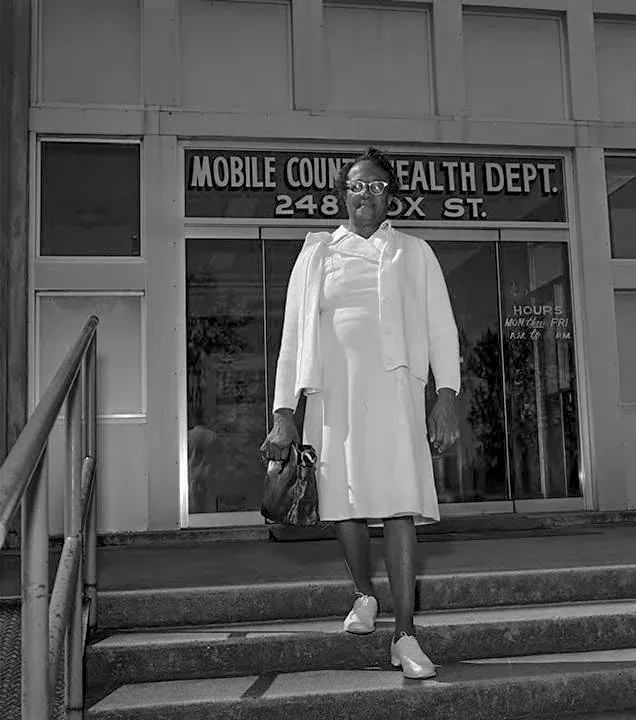
All My Babies: A Midwife’s Own Story was produced in 1953 by the Georgia Department of Public Health and directed by George C. Stoney. It follows Mary Francis Hill Coley, an African American midwife in Albany, Georgia, as she delivers babies and serves as a central figure in her community. The film was created to train midwives in hygiene and prenatal care while promoting cooperation with the modern medical system. It is a genuinely humane portrait of a Black woman doing sacred work, and it inadvertently captured the socioeconomic conditions of its era in ways that made it a significant cultural and historical document. That same film, however, was used as a public health instrument to regulate and ultimately phase out the very practitioners it depicted. Rather than resourcing the Granny midwife tradition it documented, it became a tool for reinforcing the superiority of biomedical and hospital-centric approaches over the community care that had sustained generations. Mary Francis Hill Coley was being celebrated on the screen while the system she worked within was being dismantled and planning her erasure.
What these mechanisms shared was a common logic: the appearance of progress layered over the architecture of exclusion. Each one arrived wearing the language of public health, safety, and modernization. Each one functioned to consolidate control, concentrate profit, and remove the practitioners closest to the communities they served.
We did not arrive at these statistics by chance. The shortage of Black midwives, the rising costs and the concentration of profit in institutional hands are not the unintended consequences of progress. They are the intended outcomes of a system that saw community-based reproductive care as a market to capture rather than an infrastructure to support. Capitalism was the author of this story. The next issue of Ground Work goes deeper into this history, because the more clearly we understand what was deliberately dismantled, the more precisely we can think about what our investments need to rebuild.
V. Commodifying Care: A Preview
The pattern did not end with the Grand Midwives. It is present in this very moment.
Doulas, acupuncturists, chiropractors, and community health workers are now walking the same road. Private insurance and Medicaid reimbursement have arrived, and with them the same logic that dismantled midwifery a century ago: practices and ways of existing in community, rooted in generational knowledge and relationship, were dismissed as illegitimate and not evidence-based until the system found a way to monetize them. The legitimacy did not come from the practices changing. It came from the profit potential becoming visible.
What gets lost in that transaction is worth naming carefully.
When care becomes a billing code, the time required to actually practice it disappears. Visits get capped. The unhurried presence that makes a doula or an acupuncturist or a community health worker effective is the first thing the reimbursement model cuts. The education required to continue these practices becomes gatekept through rising costs and credentialing exams that are designed in language and format that excludes many of the people closest to the communities these practices serve. The knowledge has always been there, but the barrier is new.
Most importantly, the sustainability problem does not get solved by reimbursement. It gets repackaged. Practitioners are offered low rates in exchange for higher volume, more clients, more unpaid administrative work, and more exhaustion. The system absorbs the practice and depletes the practitioner. That is not integration. It is extraction wearing a different name.
Part 2 of Issue 002 of Ground Work will examine what this looks like right now, with BIPOC clinicians inside a system that is generating profit from their presence while still not valuing their work.