Ground Work |002|Part 2| Reproductive Justice & Capitalism: Why They Were Never Separate
In Part 1 of this essay, we established what reproductive justice and capitalism are and how the pattern of extracting value from care workers while dismantling their infrastructure has been built over more than a century. That pattern did not stop with the Grand Midwives or with the billing code. It runs through the nonprofit sector, venture capital, and every funding room where decisions about care economy work are made. Part 2 of this essay names those rooms directly and names what needs to change.
Before we go there, I want to return to the ground on which this work stands.
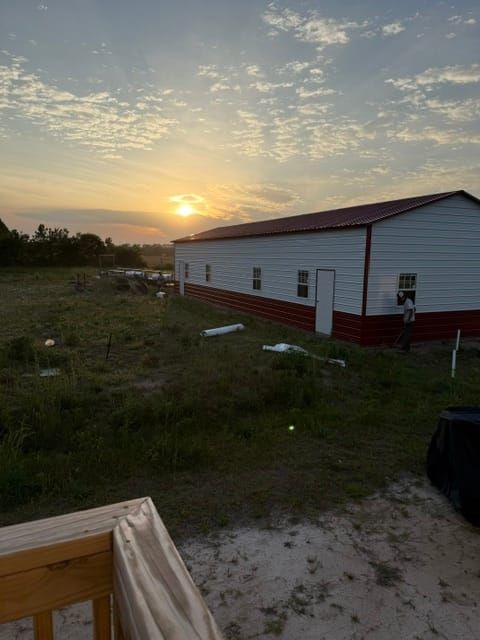
My great-great-grandparents, Barlie and Gladys, bought the land I now call Gertrude Magnolia for their liberation. My great-grandmother Ardel grew up on that land, and my grandmother Mariam was born there in the hands of Miss Virginia, our community's Grand midwife. Other family members were also born or raised on that land, though I am still learning exactly who. The land has been holding life for generations. When I think about what it means to build infrastructure that lasts, infrastructure that a great-great-grandchild might stand on a hundred years from now and understand as the ground beneath their own beginning.
That is what this second half is about. Not just naming what is broken, but understanding what it takes to build something that holds.
VI. The Nonprofit Industrial Complex
The nonprofit sector is not outside of capitalism. It is positioned that way, but positioning is not the same as reality.
Nonprofits wield power under the guise of access and community building, even when the executive director and the team genuinely intend to serve the community. The structure itself creates conditions that undermine those intentions. The questions worth asking are the same ones the reproductive justice framework demands we ask everywhere else: who sits on the board? Who controls the funding? Who decides whether an organization survives based on what feels politically safe this year? Whose priorities shape the work and whose priorities get quietly set aside when the next grant cycle opens?
The expectation placed on organizations doing transformative work on impossible budgets is itself a form of extraction. The message, spoken or unspoken, is that access to funding should produce gratitude rather than accountability. The organizations serving the communities most harmed by these systems should be thankful for whatever they receive and careful about asking for more. That sustainability is a personal responsibility rather than a structural one. This expectation does not apply evenly. It lands hardest on the organizations led by the people closest to the problems they are trying to solve.
The numbers reflect exactly that. The median Black-led nonprofit receives 300% less revenue than white-led counterparts. Fewer than 20% of nonprofit executives are people of color. While people of color make up 30% of the United States workforce, they comprise only 18% of nonprofit staff and 22% of foundation staff. The sector that claims to serve marginalized communities is not led by them, does not fund them equitably, and is not structured in ways that would allow that to change without deliberate intervention.
Restricted funding is one of the primary mechanisms that keep this in place. When funders dictate exactly how money can be spent, which programs qualify, which populations count, and which outcomes are measurable enough to justify the next grant, they are not just setting parameters; they are making decisions about what work is legitimate. That is a form of power. It is rarely named as such.
The nonprofit industrial complex is not a safety net for marginalized communities, whether you are looking at it from the side of the funder or the funded. It is often another site of extraction wearing the language of care. Recognizing that is not a reason to abandon nonprofit work. It is a reason to be clear-eyed about the conditions under which that work happens and deliberate about building something that does not require the people most affected to be grateful for the least.
(I want to add that during my time at For the Village as founder and executive director, I experienced being funded for providing doulas for Black birthing people while also being told that this new initiative was also cut financially when the focus became Black birthing people. Something was better than nothing…. Right?)
VII. Venture Capital and the Reproductive Health Miss
In 2022, I became a fellow at Vencapital, an investor accelerator that provides entry-level experience for minorities and women seeking careers in venture finance. I went in wanting to understand how I could help others build the world we hope to see. What I learned is that the problem in venture capital is not primarily a business knowledge gap on the founder side; it is a gap on the investor side.
Venture capital (VC), even when well-meaning, is centered on speed, metrics, and return on investment, filtered through the lived experience of people who have largely never had to depend on the systems they fund. The goal of returning ten times an LP’s (Limited Partner) investment can make sense for a founder ready to sell their intellectual property or their company. It does not make sense for a community resource meant to serve people equitably and sustainably over time. Those are not the same kind of business. Treating them as if they are producing predictable outcomes: underfunded infrastructure, burned-out founders, and communities that briefly had access to something before it was optimized out of existence.
I also became an angel investor, providing initial seed money for startup businesses, usually in exchange for ownership equity in the company, during that time. That experience involved sitting in Zoom meetings, listening to pitches, and reviewing decks meant to show investors why a company was valuable and could deliver returns. Often, though, no one openly talked about the knowledge gaps, limited resources, or real challenges the founders faced. Those challenges were the actual impactful factors for most founders. They are also largely invisible in a pitch because naming them feels like disqualification. Founders learn quickly what investors want to hear, and they shape their decks accordingly. The result is a funding process that rewards performance over transparency.
I focused on different things. The deck was important, but I cared more about the founder’s intention, their intersectionality, their ability to execute their plan, the skills needed to reach their community, and the real impact they could make.
That way of viewing investing became more concrete over time as founders in VC spaces began reaching out to me, not seeking funding but seeking advice. They saw that I cared about more than just making money. They needed someone who understood the difference between creating a business to sell and building something that would last. That difference is at the heart of what venture capital consistently misses in reproductive health and care-economy work. The questions that matter most in this space, such as who built the knowledge this product is based on, whose community was it developed in, whether those people are benefiting now, and what will happen to this resource if the funding runs out, are rarely asked in the rooms where the checks get written.
Until they are, the pattern this essay has been tracing will continue. New language, same extraction.
VIII. What Actually Needs to Be Done
Knowing the history is not enough. Naming the pattern is not enough. At some point, the question becomes: what does different actually look like, and who is willing to do it?
Help founders get clear before they take the money.
The most important conversation in care economy investing often happens too late, after the term sheet, after the equity is signed away, after the structure is locked in. Founders need support getting clear about their actual goals before any of that happens. Is the aim to build a community resource that outlasts them, or to build something that can be sold? Those are not the same business. They do not have the same formation, ownership structure, or definition of success. A founder who is clear about that going in is less likely to find themselves, three years later, inside a structure that works against what they set out to build.
Fund the Work That Cannot Be Rushed.
Three-year cycles do not work for community health infrastructure. Neither do five-year cycles nor ten-year cycles. Our current infrastructure was created over a century ago, so the investment horizon has to match the scale of the problem. Patient capital, meaning capital that accepts a longer return timeline in exchange for deeper community impact, is not a charitable gesture. It is the only financial model that is honest and sustainable enough to fit the work.
Repair, not just resource.
Investment in reproductive health care cannot be separated from the generational harm that created the gaps being funded. Real investment in these communities means acknowledging that harm directly and building repair into the model, not as a marketing message but as an actual commitment to redistributing what was taken. More leaders from affected communities need to be in funding seats. Access to those seats needs to become more democratic. The current concentration of decision-making power in venture capital and philanthropy is not a neutral condition. It was built, and it can be rebuilt differently.
Redefine value.
A birth center that has served the same neighborhood for twenty years holds value that does not appear on a balance sheet. Community trust is an asset. Cultural safety is an outcome measure. Intergenerational knowledge is intellectual property. The wellness industry is worth $5.6 trillion, built largely on knowledge that was never compensated for. Redefining value means building frameworks that can see what capitalism’s self-interest principle was designed to ignore. A framework that can only measure what it can monetize will always undervalue the work closest to the community and always overfund the work furthest from it.
Be present, not just invested.
Community presence is not the same as community trust. It is not an impact statement, focus group, or site visit before the check clears. It is a sustained relationship with the people most affected by the problem being addressed, before, during, and after the investment. Being led by the people closest to the problem is not a diversity initiative. It is the prerequisite for building anything that actually works.
Rethink ownership.
Using equity ownership as a control mechanism rather than a growth vehicle changes the entire arc of a community organization. A community health organization that can be bought, flipped, and optimized for a different market is not a community health organization. It is a commodity wearing that name. Cooperative models, community land trusts, and patient capital structures exist precisely because the people who built them understood that who owns something determines what it becomes. Those models are not perfect. They come with their own hardships and limitations. Founders deserve honest guidance about all of it, including the downfalls, so they can make decisions that actually align with what they are trying to build.
What it looks like in practice.
In 2020, before I entered venture capital formally, I invested $10,000 of my personal funds into The Birth Sanctuary, Alabama's first freestanding birth center. It was my first investment. I did not know then that I would go on to become a Vencapital fellow or an angel investor. I had not yet sat in a single Zoom pitch meeting or reviewed a single deck. What I knew was that this was exactly the kind of work the system had always underfunded, and I did not want to be someone who understood that and did nothing.
I made that decision through everything this essay has been building toward. I wanted my impact to be direct and unrestricted, without equity or control. The Birth Sanctuary is led by a community midwife who has blazed the path for the return of birth center presence in one of the most hostile reproductive health environments in the country. Dr. Stephanie Mitchell continues to care for community members while actively engaged in a case against the state of Alabama, a state that sits at the center of the Black home birth midwifery movement and has been working to close her birth center and minimize home birth midwifery access across the region.
That investment came before the language of impact investing was part of my vocabulary. It came before I understood term sheets or return timelines or equity structures. It came from the same place this essay comes from: the understanding that the work closest to the community is almost always the work most starved of resources, and that someone has to be willing to move first.
That is not a case study. It is a choice. It is what it looks like to put money where the argument is, without requiring a return beyond the one that matters: a birth center stays open, a midwife keeps practicing, a community keeps its access to care.
IX. Closing: The Ground Has Always Been Here
The separation between reproductive justice and capitalism was never real. It was a design choice, made by people with power, for people with power, and maintained by keeping those two conversations in separate rooms. This essay is a refusal to keep them separate.
Naming the connection is necessary. It is not sufficient. The work is building infrastructure that reflects a different set of values, and it is already happening. It is happening in pieces, in community, and often without the recognition or the resources it deserves.
In my ecosystem, Birthing Advocacy Doula Training (BADT) is training the workforce that the system spent a century pushing out. Orchid Capital is building the investment framework that community-based care has never had. For The Village resourced the community when the systems meant to do so fell short. Ground Work exists to name what is happening in real time, so that the people doing the work and the people with resources to support it can find each other, understand each other, and build something together that neither can build alone.
To the birth workers reading this: your pricing is political. Your burnout is not personal failure. Your knowledge has value that the market has never honestly accounted for, and the history in these pages is yours to claim and to use.
To the investors reading this: the opportunity in reproductive health and care economy work is real. So is the responsibility. Writing a check without this context does not make you an impact investor. It makes you the next chapter in a story this essay has already told. You have the ability to write a different one.
The ground has always been here. Barlie and Gladys knew it. The Grand Midwives knew it. Mary Francis Hill Coley knew it. Every doula who has ever sat with a laboring person in a system that did not want either of them there has known it.
What gets built on this ground is still being decided. The ground has always been here. So have we. It is time to build.