Money Talk #1 | What My First Book Deal Actually Paid Me
Welcome to the first edition of Money Talk, a series where I pull back the curtain on the real numbers, contracts, and financial behind-the-scenes of my creative and business projects!
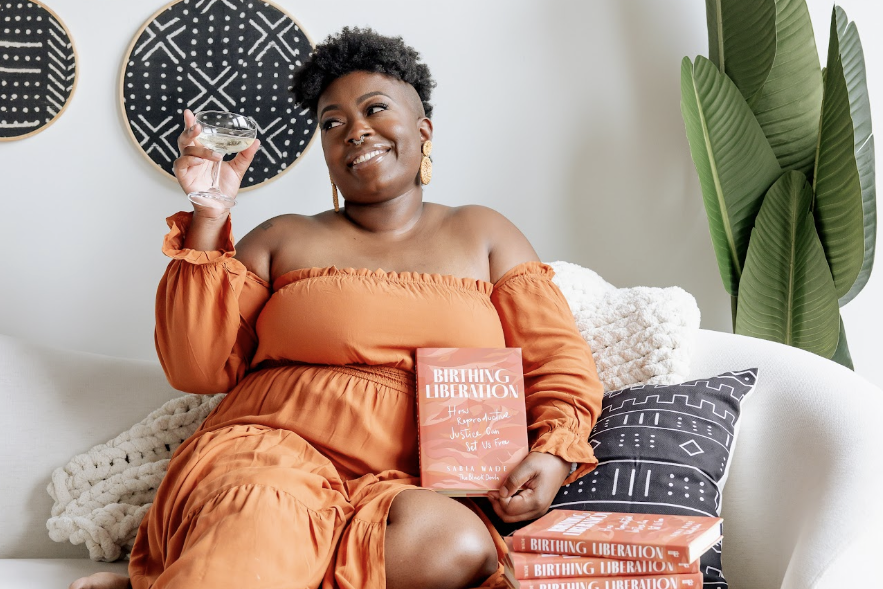
It took about four and a half years from signing my contract to my first royalty check, and my book, Birthing Liberation, released on March 7, 2023, beat the industry averages. I sold more copies than the average traditionally published book and earned out my advance. However, it also wasn’t a living wage, though it did move me to a new level in my career in several ways. I’m going to lay out all the numbers and tidbits I learned along the way.
I. The numbers
- The sales: My first book, Birthing Liberation, has sold 4,250 copies as of June 30, 2026.
- The payout: My advance was $12,000, and after my agent's cut, the book has paid me $10,847.90 before taxes.
- The royalties: I earned out my advance and began earning royalties once my statement hit 3,972 combined hardcover and e-book sales. Thus far, I’ve received two royalty payments: $312.29 on April 1, 2026, and $449.94 on October 1, 2026.
II. The timeline
| Milestone | Date |
|---|---|
| Signed with book agent | February 2021 |
| Book contract signed (first $6,000) | August 2021 |
| Manuscript accepted (second $6,000) | June 2022 |
| Hardcover released | March 7, 2023 |
| First royalty payment | April 1, 2026 |
| Paperback released | May 2026 |
| Second royalty payment | October 1, 2026 |
Over four years passed between signing my contract and seeing my first royalty check. To be honest, it didn’t feel like four years because I am still actively receiving opportunities from Birthing Liberation.
When I first started talking to agents in 2021, I met with two major agents who represent authors with huge book deals, New York Times bestsellers, and massive public platforms. At first, that was exciting until both of them suggested I water down my message and be less of myself. Then I found Laura Lee Mattingly at Present Perfect. She was into my proposal, understood my why, and gave me honest feedback on where I could find the most freedom to be myself and the most support for my book launch. It meant maybe not getting the highest advance upfront, and I was more than okay with that.
Both Feminist Press and Chicago Review Press were interested in signing me. I ultimately went with Chicago Review Press because of their dedication to my writing process, my launch, and helping me land opportunities. I also vibed so well with Kara Rota, my editor, who always pushed me to be even more honest and authentic during the writing process. The day Laura Lee emailed me to say I was receiving my first royalty check felt like confirmation, especially because I had just started writing the proposal for my next book, Full Spectrum.
Fun fact-ish (because many publishers don’t put out this info): Most literary agents, editors, and industry insiders estimate that 50% to 70% of traditionally published books do not earn out their advances. Some publisher and trade estimates suggest that roughly 25% to 30% of books from major ("Big 5") publishers actually earn out.
III. The financial breakdown
| Item | Amount |
|---|---|
| Advance (two installments) | $12,000.00 |
| Royalty payments | $762.23 |
| Paid to me directly | $12,762.23 |
| Agent commission (Present Perfect, 15%) | -$1,914.33 |
| Net before taxes | $10,847.90 |
| Per year, spread over ~4.5 years (estimate) | ~$2,800 before agent's cut / ~$2,400 after |
| Audiobook license ($5,000 total) | $2,500 credited toward my advance |
IV. How the money works
- The advance is a loan against future sales: An advance is an early payment against royalties, not a bonus.
- The earn-out threshold: I earned no royalties until sales reached 3,972 combined hardcover and e-book copies.
- Royalty rates: For hardcover, I earn 10% of the retail price up to 10,000 copies, and 12.5% thereafter. For paperback, I earn 7.5% of retail up to 15,000 copies, and 10% thereafter. E-book royalties are 25% of net sales.
- Subsidiary income: The audiobook license brought in $5,000 total. My $2,500 share went directly toward paying back and earning out my advance.
V. Where my book sits: where I beat the averages and where I did not
| Metric | Commonly Cited Average | My Book | Beat It? |
|---|---|---|---|
| Lifetime sales | ~3,000 copies (~250 in year one) | 4,250 copies | Yes |
| Earning out | ~25% of books (industry estimate) | Earned out | Yes |
| Advance (nonfiction) | $17,500 median (survey of 96 authors) | $12,000 | No |
| Annual book income (all authors) | $2,000 (Authors Guild 2023) | ~$2,400 to $2,800 | Slightly above |
| Annual book income (full-time) | $10,000 (Authors Guild 2023) | Not a like-for-like comparison | Context only |
What "average" hides
Beating the average sounds like a win, and in one way it is. An average is also just one number standing in for a very wide range of books, and it says nothing about what an author can actually live on.
The figure I trust most comes from the Authors Guild. Its 2023 Author Income Survey of 5,699 authors found a median book income of $2,000 across all authors (part-time included), and $10,000 for full-time authors. I am not a full-time author, so the fair comparison is the $2,000. Spread across the four and a half years since I signed, my book paid me about $2,800 a year before my agent's cut and about $2,400 after, before taxes. That sits a little above the median for all authors, while the full-time median shows how far even a successful book sits from a living wage.
VI. What the book opened
The book's royalties are only part of what it paid me. Birthing Liberation also led to paid speaking engagements, organizational consulting, individual mentorship, staff trainings, podcast guest spots, college lectures, talks for medical practitioners, and course adoptions, showing up on syllabi everywhere from universities to midwifery schools and doula trainings.
Over the last four years, the opportunities connected directly to the book (not including sales from my own organization, Birthing Advocacy Doula Trainings) have brought in well into the low-to-mid six figures, and I might actually be underestimating that. I went into writing Birthing Liberation knowing I was ready to carry my message into rooms I couldn't reach on my own, and knowing a book takes on a life of its own. In all honesty, a book is rarely the whole return. More often, it’s the credential that makes the next paid thing possible. That is worth knowing before you sign, and the future you are envisioning is worth discussing with your agent to help you both understand the goals and how to position the book realistically.
VII. The choices
- Taking a traditional independent deal: I chose Chicago Review Press because I loved the team and had the ability to be myself at all times. I felt supported even when I asked to extend my writing time and push out my release date. The trade-off was a smaller upfront advance, and although CRP did marketing for me as their lead book for the season, they didn't have the budget of a Big 5 publisher, so I also did a lot of marketing and book tour planning myself.
- Hiring an agent at 15%: The book industry is a whole beast, and truly I don’t know how I would have navigated it on my own. Signing with Laura Lee was a necessity. I moved into contracts feeling informed, especially when so much of the business of books happens behind closed doors. You don’t know unless you know, and I didn’t know shit. Sure, I could have kept that 15%, but the representation was well worth it. Even as I self-publish my next book, I’m still doing it with Laura Lee by my side.
- Licensing the audiobook: It was super important to me for my book to be accessible, and an audiobook is the way. I truly didn’t expect an audiobook deal before my book was even released, and the narrator even sent me a message saying she enjoyed reading it. I did audition to read it myself, but this heavy Jersey accent wasn’t ready for all that yet. The cost was definitely folks asking me why I didn’t narrate my own book, so for this next one, I’m doing it myself.
- Rights I gave up: Giving up World rights with a 50/50 split on subsidiary rights was my biggest concession. Agented deals can sometimes keep translation rights with the author, or split them 75/25 or 80/20 in the author’s favor. With World rights at 50/50, the publisher keeps half of every foreign or translation deal, and my half went toward paying back my advance first. Audio is worth watching too: if a publisher licenses audio out, you split that income; if they produce it themselves, you get a royalty instead. I didn't know much about rights the first time around, though I still feel my deal was fair for where I was. Now, understanding much more about my audience and my reach, I'm approaching this differently the second time around.
- Self-publishing Full Spectrum: With my second book, I already have the community, the distribution channels, and the proof that my audience shows up. (Thanks y'all!) Self-publishing lets me retain 100% of my intellectual property, control the timeline and creative direction from start to finish, and keep the majority of every dollar a book brings in rather than waiting years to earn out a 10% royalty.
VIII. What I would change
I wouldn't trade the editorial care I got on my first book, though knowing what I know now about the doors a book opens, I would have negotiated harder to hold onto my foreign and translation rights rather than handing over a 50/50 World rights split right out of the gate.
IX. The capital story
When we talk about book deals, we have to talk about who owns the work, who profits from it, and what that means for Black authors and care workers.
The Authors Guild survey lays the racial wealth gap in publishing bare: among all Black authors (part-time included), the median annual book income was $800, compared to $2,000 for white authors. Among full-time Black authors, the median was $2,412 against $10,985 for full-time white authors. My estimated $2,400 to $2,800 a year sits well above that $800 median, and naming that gap matters, because even beating the industry average as a Black author doesn't mean the system is built to sustain us. Furthermore, the report found that white authors were 36% more likely to be traditionally published than Black authors in the first place.
As a Black queer author writing about reproductive justice, full spectrum birth work, and liberation, I felt that gatekeeping early on when major agents wanted me to water down my politics to make my message more palatable. Finding an agent and an editor who protected my voice made all the difference, and it taught me what other Black and queer writers need to demand before signing anything: final say over your voice and edits, clear, written commitments on what marketing support the publisher is actually providing, and a closer look at subsidiary rights so you aren't signing away your intellectual property for pennies on the dollar.
X. Your turn
If you are looking at a book deal, or thinking about pitching one, don't get distracted by the advance number alone. Pay close attention to how your advance is broken into installments (because it could be years between payments), what your royalty rates are by format, how many copies it actually takes to earn out, what percentage your agent takes and on which rights, and which subsidiary rights (audio, foreign, translation) you are signing away.
Next in Money Talk: I’m breaking down the real budget (it ain't cheap that's for damn sure lol), production costs, and pricing math behind self-publishing my next book, Full Spectrum: A Doula's Guide to Reproductive Justice and Care Work!